DNS Nameserver Resilience in Egypt: We Scanned 332 .eg Domains
Summary: On 7 November 2026 at 09:32 Cairo time, Smart One Group checked the nameserver setup of all 332 Egyptian .eg domains in Tranco list 262N9. Of 272 domains with their own DNS delegation, 65.4% rely on fewer than three nameservers, 86.4% rely on a single DNS operator, and for 22.8% every nameserver IPv4 address sits inside one /24 network. We also found 19 domains (7.0%) publishing nameserver names that are invalid or do not resolve publicly. An 8-step resilience checklist follows.
When your domain's authoritative nameserver set stops answering, everything disappears at once: the website, email, booking portals, and the clinic and ERP systems your staff reach over the internet. Strong hosting and a well-built application do not help, because users never learn the server's address. Authoritative DNS resilience is therefore a core business-continuity layer, yet Egyptian companies and public bodies rarely review it after first registering a domain.
What is a nameserver and why does it decide whether your site stays online?
Authoritative nameservers are the servers that hold the official copy of your domain's records and answer every query for your website or mail server address. They are listed in NS records at the parent registry (such as the .eg registry) and inside your own zone. If all of them fail at the same time, resolvers cannot find any record once their cached copies expire.
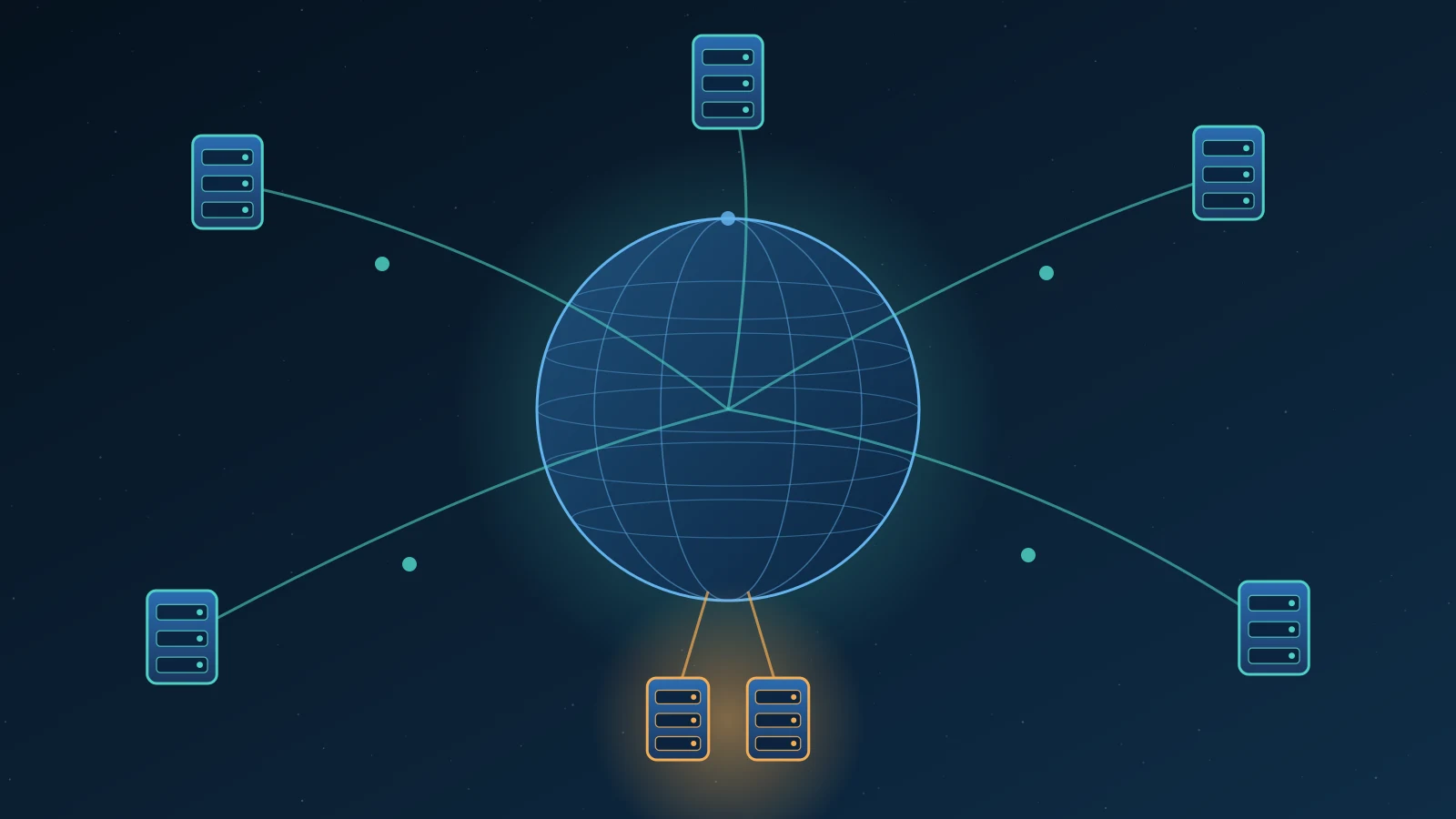
In one quotable sentence: DNS resilience means your domain has no single point of failure; its nameservers are spread across more than one network, more than one location and, ideally, more than one operator.
The principle is old. RFC 2182 (BCP 16) says secondary servers must be placed at topologically and geographically dispersed locations to minimise the chance that a single failure disables all of them, and recommends three servers for most organisation-level zones, with at least one well removed from the others.
Why check DNS resilience now?
On 1 November 2026, the free host InfinityFree reported on its status page that one of its nameservers stopped responding from its US-west monitoring location; the problem grew until none of its nameservers answered from that location, and the incident lasted 7 hours 25 minutes. The lesson is simple: several nameserver names are not enough if they all run with one provider or in one place.
We have already covered DNSSEC signing and email security for Egyptian domains, but we found no published Arabic-language check of how diverse .eg nameservers are by count, network and operator. This article fills that gap.
How Smart One Group ran the scan
We used the same list as our earlier studies: 332 Egyptian domains from Tranco list 262N9. On 7 November 2026 at 09:32 Cairo time we queried, over DNS-over-HTTPS (Google, with Cloudflare as fallback):
- NS and SOA records for every domain.
- IPv4 and IPv6 addresses for every nameserver name (414 names and 572 IPv4 addresses).
- The origin autonomous system (ASN) and registration country for each IPv4 address, via Team Cymru.
We found 59 names without their own delegation; they are served directly from a parent zone (29 from gov.eg, 24 from edu.eg and a few others), so their resilience follows that parent's servers. One more domain returned no NS records despite having a zone. That leaves a base of 272 independently delegated domains.
Nameserver findings for Egyptian domains
- Count: 178 domains (65.4%) have fewer than three nameservers; 12 (4.4%) have only one and 166 have two.
- Operator: 235 domains (86.4%) depend on a single DNS operator; only 37 (13.6%) combine two or more.
- Small operator: 136 domains (50.0%) depend on one operator that is not a large global anycast DNS provider.
- Network: for 188 domains (69.1%) all nameserver addresses are in one autonomous system; for 62 (22.8%) they are all in one /24, none of them on a large provider.
- Invalid names: 19 domains (7.0%) publish a nameserver name that does not resolve publicly: 8 single-label names, 6 internal names ending in .local, 2 IP addresses written as names, and 3 public names with no address.
- IPv6: 122 domains (44.9%) have at least one nameserver reachable over IPv6.
- Location: for 82 domains (30.1%) all nameservers are in Egypt-registered networks; 140 (51.5%) have none in an Egyptian network.
Cloudflare was the most common operator (64 domains, 23.5%). In SOA records, 42 of 271 domains set Expire below one week, while RFC 1912 suggests two to four weeks for zones that rely on transfers between a primary and secondaries.
Comparison by zone
| Zone | Delegated domains | All in one /24 | Single ASN | Any IPv6 nameserver | Invalid nameserver name |
|---|---|---|---|---|---|
| gov.eg | 58 | 16 (27.6%) | 30 (51.7%) | 12 (20.7%) | 6 (10.3%) |
| edu.eg | 68 | 21 (30.9%) | 54 (79.4%) | 29 (42.6%) | 7 (10.3%) |
| com.eg | 89 | 17 (19.1%) | 63 (70.8%) | 44 (49.4%) | 4 (4.5%) |
| bare .eg | 45 | 3 (6.7%) | 33 (73.3%) | 34 (75.6%) | 0 (0.0%) |
Notably, the .eg zone itself follows the principle: it has three nameservers in three different autonomous systems, two of them in networks registered outside Egypt, one at the University of Vienna. Many government and university domains, by contrast, place both nameservers on the same network, which RFC 2182 explicitly calls not a good policy.
What the numbers mean for a company or clinic
Relying on one large operator such as Cloudflare or AWS is not a mistake in itself, because those networks are globally distributed. The bigger risk lies in two patterns: two servers on one /24 in a single data centre, or mistyped nameserver names that make part of the delegation useless. In both cases everything may work day to day, then the website and email go down together at the first power cut or upstream failure.
Adding names alone is not enough either; four nameserver names pointing to the same machine are less resilient than two real servers on two different networks.
An 8-step checklist for nameserver resilience
- Inventory the delegation: record the nameservers listed at the registry and inside the zone, and make sure both lists match.
- Fix the names: remove any single-label name, any name ending in .local, or any IP written as a name; use a fully qualified name with a public A or AAAA record.
- At least three servers: follow RFC 2182 and run three servers for most organisation zones, one well removed from the others.
- Diversify networks: do not place every server in one /24 or behind one upstream provider.
- Consider a second operator: for critical domains, add secondary DNS with a different operator, using zone transfer or automated sync.
- Enable IPv6: make at least one nameserver reachable over IPv6.
- Review SOA: if you use secondaries, set Expire to cover the longest outage you expect on the primary.
- Monitor and test: add external monitoring for each nameserver, run a planned failover test once a year, and coordinate changes with DNSSEC if it is enabled.
Read our article on DNSSEC signing for Egyptian domains before changing nameservers, because moving a zone between operators requires careful key and DS record handling.
How Smart One Group can help
Our domain services cover registration and management of .eg and generic domains with a delegation review, and our hosting and server services include multi-site DNS design for websites, clinic and ERP systems, and email. For a short report on your own domain, contact our team.
Frequently asked questions
How many nameservers does my company domain need?
RFC 2182 recommends three servers for most organisation zones, with one topologically and geographically distant from the rest. We found that 65.4% of the Egyptian domains we checked have fewer than three.
Is using Cloudflare alone a single point of failure?
It is reliance on one operator, but that network is globally distributed, so the risk differs from two servers in one data centre. Highly sensitive domains can add a second operator.
What does it mean if all nameservers are in one /24?
It means the server addresses sit in one contiguous address block, usually at the same provider, so a single routing fault or outage can take them all down. This applied to 22.8% of the domains we checked.
Why is a nameserver name like ns1.local wrong?
Internal and single-label names do not resolve on the public internet, so resolvers cannot use them; part of the delegation becomes worthless and lookups slow down.
Does changing nameservers affect email?
Yes, because MX, SPF and DKIM records are served by the same servers. Copy the full zone to the new operator and verify it before changing the delegation at the registry.
Do the results name specific domains?
No. We report aggregates only, without naming organisations. The data is a point-in-time snapshot from one vantage point over DNS-over-HTTPS and may change as owners update their settings.