Open Graph Link Previews in Egypt: We Checked 332 .eg Websites
Summary: On 8 November 2026 (09:36 Cairo time), Smart One Group checked Open Graph link-preview readiness on the homepages of all 332 Egyptian domains in the Tranco list (version 262N9). Of the 261 homepages we could load, 49.8% have no Open Graph tags at all, only 27.2% serve a preview image that actually works, and just 6.5% are fully ready (title, description, URL and an image of at least 1200×630). An 8-step fix list closes the article.
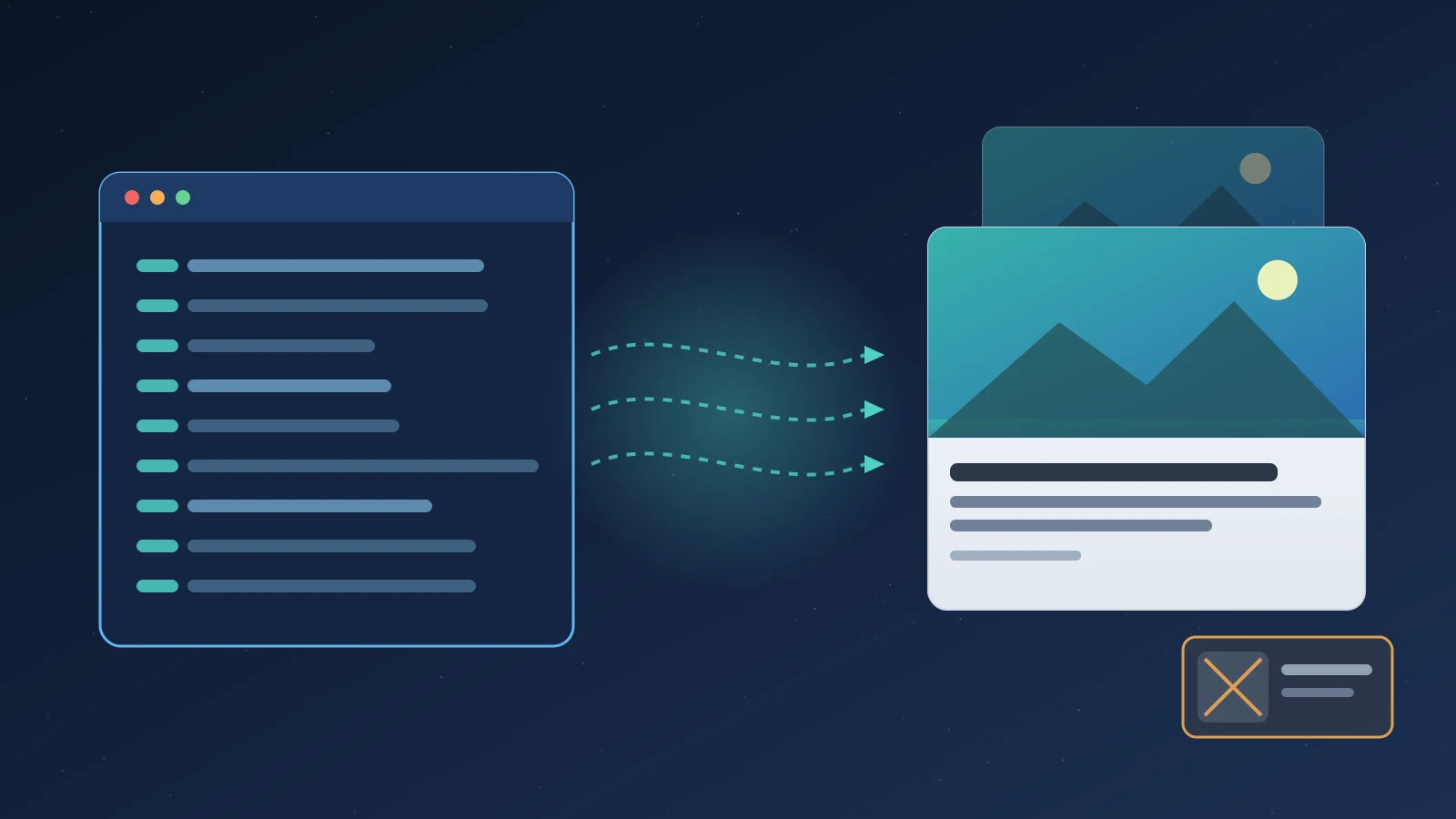
When a customer or employee shares your website on Facebook, LinkedIn or a messaging app, people do not see your site first. They see a link preview: a small card with an image, a title and a description, built from your Open Graph tags. That card decides in a second whether someone clicks or scrolls past. Yet Egyptian companies, clinics and public bodies rarely review it after launch, so their links often appear with no image, a cropped logo or a title that has nothing to do with the page.
What are link previews and Open Graph tags?
A link preview is the card that social platforms and messaging apps generate automatically when a URL is shared, based on metadata the site owner places in the page head. The best-known standard is the Open Graph protocol, which defines four required properties for every page: og:title, og:type, og:image and og:url, plus optional ones such as og:description, og:site_name and og:locale.
In one quotable sentence: Open Graph tags are the ID card your website hands to every platform that reads its links; when they are missing, the platform guesses, and it often guesses wrong.
Meta's sharing image requirements state that the minimum allowed image dimension is 200×200 pixels, the file must not exceed 8 MB, and images of at least 1200×630 pixels close to a 1.91:1 ratio are recommended. LinkedIn lists og:title, og:image, og:description and og:url as tags that must exist, with a minimum image size of 1200×627 pixels and a 5 MB maximum.
| Requirement | Meta (Facebook) | |
|---|---|---|
| Minimum dimensions | 200×200 px | 1200×627 px |
| Recommended dimensions | 1200×630 px or larger | 1200×627 px or larger |
| Recommended ratio | Close to 1.91:1 | 1.91:1 |
| Maximum file size | 8 MB | 5 MB |
How we ran the scan
We used the same list of 332 Egyptian domains as our previous scans: every .eg domain in the Tranco list of top sites (version 262N9). The method was:
- We requested each homepage over HTTPS twice: once with a normal browser user agent and once with Facebook's crawler user agent (facebookexternalhit), because the crawler is what actually builds the card.
- We read og: and twitter: tags from the page head, then downloaded the og:image with the crawler user agent and recorded the status code, file type, pixel dimensions and size.
- 261 homepages loaded as HTML; the remaining domains did not respond or did not return an HTML page and were excluded.
Open Graph scan results for Egyptian websites
| Metric | Count | Share |
|---|---|---|
| Pages with no Open Graph tags at all | 130 of 261 | 49.8% |
| Pages with og:title | 116 | 44.4% |
| Pages declaring og:image | 91 | 34.9% |
| Pages with a working preview image | 71 | 27.2% |
| Pages with all four required Open Graph properties | 66 | 25.3% |
| Fully ready pages (title, description, URL, image of 1200×630 or larger) | 17 | 6.5% |
| Pages with image alt text (og:image:alt) | 18 | 6.9% |
Half of the sites have no Open Graph tags
130 homepages (49.8%) carry no Open Graph tags whatsoever. Each platform then tries to infer a title and image from the page content: it may pick a tiny logo, a random sidebar image, or no image at all. Notably, 57.1% of pages do have a search-engine meta description, so many sites took care of search engines but forgot social platforms.
The image is the weakest link
Of the 91 pages that declare an og:image, the image failed to load or could not be decoded in 20 cases (22.0%), including server 500 errors, 403 and 404 responses, and files that are not readable images. In addition, 12.1% of these pages use a relative path instead of a full URL, and 9.9% point to an image over unencrypted HTTP.
Even among the 71 working images:
- 42.3% are smaller than 600×315 pixels, which Meta describes as the minimum for the larger link-post image.
- 14.1% are below Meta's minimum allowed 200×200 pixels.
- 31.0% are square, usually the logo itself, which gets cropped or shown small.
- Only 33.8% reach 1200×630 pixels or more, and only 26.8% are close to the 1.91:1 ratio.
Clear differences by domain type
| Domain type | Pages | No Open Graph | Working image |
|---|---|---|---|
| com.eg | 70 | 37.1% | 38.6% |
| Bare .eg | 39 | 28.2% | 28.2% |
| gov.eg | 66 | 59.1% | 24.2% |
| edu.eg | 80 | 60.0% | 21.2% |
Commercial com.eg sites do relatively best, yet more than a third still have no tags. Government gov.eg and university edu.eg sites lack Open Graph on roughly six in ten homepages, even though their links are shared daily for admissions and public services.
Arabic settings in og:locale
Of 105 pages declared as Arabic, only 31 include og:locale. Across the whole sample we found different values for the same language, such as ar_AR, ar_EG, ar_SA, ar_AA and ar-EG, and 7 values that do not follow the language_TERRITORY format defined by the protocol. It is a small detail, but it shows that tags are often copied from templates without review.
When the crawler itself is blocked
We found 11 sites that open normally for a browser but did not return a valid page to Facebook's crawler user agent, including 6 outright 403 refusals. The cause may be a firewall or bot-blocking rule, and the result is that the platform never sees your tags, however correct they are.
Why link previews matter for marketing and business
Almost every campaign ends in a link: a sponsored post, a message to a customer, or the link in a company profile. If the card shows no image or a generic title, the campaign quietly loses attention, and no report will show it. Fixing the card does not require a redesign, only a few lines in the page head and an image designed at the right size. In an earlier article we covered how Google recognises your site name and favicon; link previews are the social-platform side of the same identity question.
An 8-step checklist to fix your Open Graph link previews
- Add the core tags to every page: og:title, og:description, og:image, og:url and og:type, plus og:site_name with your company name.
- Design a dedicated share image: 1200×630 pixels at 1.91:1, not the square logo, with a moderate file size.
- Use a full HTTPS URL for the image: and confirm it returns 200 with a proper image content type.
- Give every key page its own card: service, product and article pages need their own title and image, not the homepage card.
- Set the language: use og:locale in the correct format, such as ar_EG for the Arabic version, and og:locale:alternate for the English one.
- Add X tags: twitter:card set to summary_large_image for a large image, and og:image:alt to describe the image.
- Do not block preview crawlers: review firewall and bot-protection rules so platform crawlers are not refused.
- Test after every change: use Meta's Sharing Debugger, and remember that Meta caches images by URL, so change the image URL when you update it.
At Smart One Group we build these settings into our web development services and review them with our digital marketing team before any campaign launches.
Frequently asked questions
Why does my website link appear without an image when shared?
Usually because the page has no og:image tag, or the declared image does not load for the crawler due to an error, blocking or a relative URL. In our scan, only 27.2% of Egyptian homepages serve a working preview image.
What is the right size for a link preview image?
The safest size is 1200×630 pixels at 1.91:1. It meets Meta's recommendation and sits right at LinkedIn's minimum of 1200×627 pixels.
Is the meta description for search engines enough?
No. Some platforms may fall back to it, but og:description is the tag designed for previews, and LinkedIn lists it among the required tags.
I changed the image but the old preview still shows. Why?
Platforms cache previews. Meta states that images are cached by URL and are not updated unless the URL changes, so use a new file name and re-check with the Sharing Debugger.
Do Open Graph tags affect Google rankings?
Open Graph tags are not a declared Google ranking factor, but they affect click-through when links are shared, and that traffic supports marketing indirectly.
Do I need different tags for the Arabic and English versions?
Yes. Each version should have a title and description in its own language, a matching og:locale, and ideally an image that does not rely on text in a single language.
Methodology notes: this is a single snapshot from one network vantage point, covering homepages only; inner pages may differ. Some server errors or blocks may be temporary or specific to our scanning address, and no organisation is named.
If you would like a review of how your links look on social platforms and a fix for your preview tags and images, contact the Smart One Group team and we will send you a short report of what needs to change.